Lucky Bay - Wallaroo
Ferries to Australia
Lucky Bay - Wallaroo
Ferries to Australia
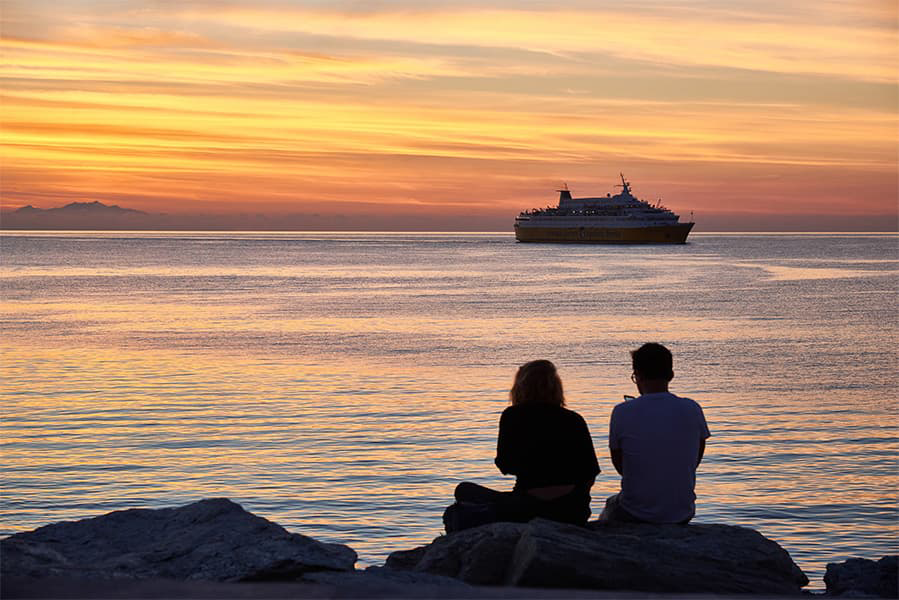
We offer a fast way to compare ferry tickets and costs across the world to make your choice smooth sailing. Check out our Special Offers page for discounts on select routes and operators. Remember to book early for the best prices and options!
Yes, Direct Ferries offers a wide range of discounts all year round. When searching for ferries, senior discounts will be automatically applied if they are available. Just select your age range from the passenger options.
Students and graduates can get a 5% discount on ferry tickets. To take advantage of the discount, you need to register with and check out our partner Student Beans and confirm your student or graduate status. You will then receive a discount code which can be entered during the payment process.
Resident discounts are available on a variety of Spanish and Italian ferry routes. Just click on the "Residents" option when this is displayed. The discount is automatically applied to the price. Bear in mind that proof of registration or an identity card with the correct address must be shown at check-in.
Travel requirements can vary depending on the route, so make sure to check what documents you'll need before sailing. In most cases, a valid passport is required when travelling from Lucky Bay to Wallaroo, along with any necessary visas or national ID cards. Requirements may differ based on your nationality and the destination country’s regulations. To avoid delays at check-in, you can find helpful information for your journey in our Check-in, Travel Documents & Tickets guide.
To book your ferry tickets, simply enter your departure and arrival ports along with your preferred travel date to see all available options and prices. You can also view alternative routes and sailing times, helping you find the best deal for your needs.
Keep an eye out for early booking discounts and special ticket options, such as upgrades or flexi-tickets that let you change or cancel your booking. To ensure a smooth sailing experience, make sure you enter all the required details correctly, including the number of passengers and your vehicle specifications.
Once you’ve completed your booking, you’ll receive a confirmation email. How your boarding pass is issued and collected depends on the ferry operator you’ve booked with.
Some ferry operators issue your boarding pass as soon as your booking is confirmed, while others require you to check in at the port. Some may also offer online check-in, which can be completed easily via the Direct Ferries app, where available.
The ticket desks are usually located near the ferry terminals. To avoid any delays at the port, we’d recommend allowing some extra time to collect your tickets and to check in.
During check-in, you must show your email confirmation, as well as an official photo ID, such as a passport or identity card. You might also be asked to provide documentation for your pet (vaccines, pet insurance, etc.) or proof of residence, if you have booked your ticket with a resident discount.
There could be several reasons why there are no departures from Lucky Bay to Wallaroo on your chosen date. This could be due to a temporary timetable change, limited availability or seasonal timetable variations. We recommend checking alternative dates and routes to find a suitable crossing.
The best time to book a ferry from Lucky Bay to Wallaroo is generally as early as possible. Booking in advance can help you secure the best available prices, as well as a wider choice of departure times and cabin or seating options.
We recommend booking at least a few weeks ahead to take advantage of the best offers. Keep in mind that prices can vary depending on the season and availability.
More routes than anyone else.

Compare fares, times & routes in one place.
Change plans easily with flexi tickets.

Book e-tickets & manage trips in-app.
Live ship tracking & real-time updates.

Top-rated customer support when you need it.
Located on the Eyre Peninsular in South Australia is Luck Bay. The bay was named Lucky Bay by Matthew Flinders when he was exploring Australia's south coast in 1802. He took a dangerous route through the Recherche Archipelago and took cover in the bay from a summer storm. Whilst in anchored in the bay, Flinders' botanist, Robert Brown, discovered many new species of flora whilst exploring the area. The bay is the perfect location to swim, to snorkel, to fish and for surfing and launching small boats. However, visitors should note that the beaches can be tricky for vehicles as it is easy for them to become bogged down in the most innocent looking wet or dry sand.
The Bay's port is the terminus of SeaSA's Spencer Gulf passenger ferry service which operates across the Spencer Gulf between Lucky Bay and Wallaroo. The service, which is for passengers and vehicles, received the Australian Marine Environment Protection Association award in 2006 'for its potential to save more than 25,000 tonnes of carbon emissions annually from road traffic by providing a cross-Gulf alternative to the lengthy round-Gulf car trip'.
The Australian town of Wallaroo is a popular holiday destination which is around 160 km to the north of Adelaide and offers visitors excellent swimming and fishing and is a great place to relax. One of the most popular destinations for fishing in the State is the Wallaroo Jetty whilst underneath the Jetty there is a wide variety of sea life and is popular with scuba divers. The town is home to a deep sea port and is the home port of the Spencer Gulf prawn fleet. Also, along with a multi-million dollar marina, Wallaroo has many attractions and is also the home of the Sea SA Car and Passenger Ferry that makes daily crossings from Wallaroo to Lucky Bay on the Eyre Peninsular.
The town was founded in 1861 and was later declared a town in 1862. The town's population peaked at 5,000 in 1920 and the port was the Yorke Peninsula's largest and most important port in 1923 when copper production ceased, and was also the largest and most important on the Spencer Gulf until the Port Piries smelters were established in the late 19th century.